Even heat, restored
Radiators that were cold at the bottom heat across the whole panel again, so the rooms you were compensating for come up to temperature.
Gas Safe Reg. 638860|24-hour emergency cover, Essex & Suffolk
Powerflushing & system cleaning
Cold-at-the-bottom radiators, banging pipes and a boiler working harder every year are symptoms of one thing: magnetite sludge. A powerflush clears it, restores even heat and stops the system eating boiler components.
Gas Safe 638860 · Inhibitor and filter fitted · 6-month workmanship guarantee
8 years in business
Eight years of gas and plumbing work
Gas Safe 638860
Full domestic scope
10/10 on Checkatrade
27 verified reviews
£2m public liability
Fully insured
6-month guarantee
On all workmanship
Service overview
Every sealed heating system slowly produces magnetite, black iron oxide sludge, as steel radiators corrode internally. That sludge is carried around the system by the pump, settles in the bottom of radiators, coats heat exchange surfaces and blocks narrow passages. It is the single most common underlying cause of the heating faults we attend across Essex and Suffolk.
A powerflush uses a high-flow, low-pressure pumping unit connected to the system, combined with chemical cleaners and a magnetic filter, to move that debris out rather than simply stirring it around. Radiators are flushed individually, flow is reversed to dislodge settled deposits, and the system is rinsed until the water runs clear.
The job finishes with a full dose of corrosion inhibitor and, where one is not already fitted, a magnetic system filter. Without those last two steps a flush is a temporary result: the same corrosion process starts again the moment the system is refilled.
The cost of waiting
Sludge does not stay in the radiators. It circulates, and the components it reaches are the expensive ones. Pumps seize, diverter valves stick, and boiler heat exchangers become restricted, at which point the boiler overheats locally, kettles, cycles and eventually locks out. What began as a cold radiator ends as a boiler repair or replacement.
There is a warranty dimension too. Manufacturer warranties assume the appliance runs on clean, inhibited water. A new boiler installed onto a heavily contaminated system, or run for years with no inhibitor, can find itself in a difficult warranty conversation about water quality when the heat exchanger blocks.
In the meantime you are paying for it in gas. A system that cannot circulate freely forces the boiler to run longer and hotter to reach the same room temperatures, and prevents a condensing boiler from returning water cool enough to condense, which is where its efficiency advantage comes from in the first place.
Our process
We check radiator temperature patterns, water condition, filter contents and boiler behaviour to confirm sludge is the cause and that the system is suitable for flushing.
The powerflush unit is connected and cleaning chemicals are circulated through the system to break down magnetite and scale deposits.
Each radiator is isolated and flushed individually with flow reversal, so debris settled in the bottom of the panels is actually removed rather than moved.
The system is rinsed until the water runs clear, with the magnetic filter capturing residual debris and radiator temperatures re-checked across the property.
Full dose of corrosion inhibitor, magnetic filter fitted where absent, system balanced, and the work backed by our 6-month workmanship guarantee.
What you get
Radiators that were cold at the bottom heat across the whole panel again, so the rooms you were compensating for come up to temperature.
A freely circulating, clean system lets the boiler reach temperature faster and lets a condensing boiler actually condense.
Removing circulating magnetite is the cheapest available protection for pumps, valves and heat exchangers.
Clean, inhibited water with a magnetic filter fitted is the water quality condition manufacturers expect.
Kettling, banging and pump noise almost always trace back to deposits and restricted flow.
Registration 638860 covers the boiler side too, so if the flush reveals an appliance fault it is diagnosed by the same person.
In detail
Not every system needs a powerflush. Where contamination is mild and the system is otherwise healthy, a chemical clean and thorough flush with inhibitor and a magnetic filter is proportionate and considerably cheaper. We say that at survey rather than selling the biggest job available.
A powerflush is the right answer where radiators are cold at the bottom, the water runs black, the pump has struggled, or the system has never been treated. It is also the sensible option before a new boiler goes onto an old system, because the new appliance inherits whatever the old pipework is holding.
A magnetic filter is not an alternative to cleaning; it is what keeps the system clean afterwards. It captures circulating iron oxide continuously and is emptied at each annual service. Fitting one on a dirty system without cleaning it first just means an immediately full filter.
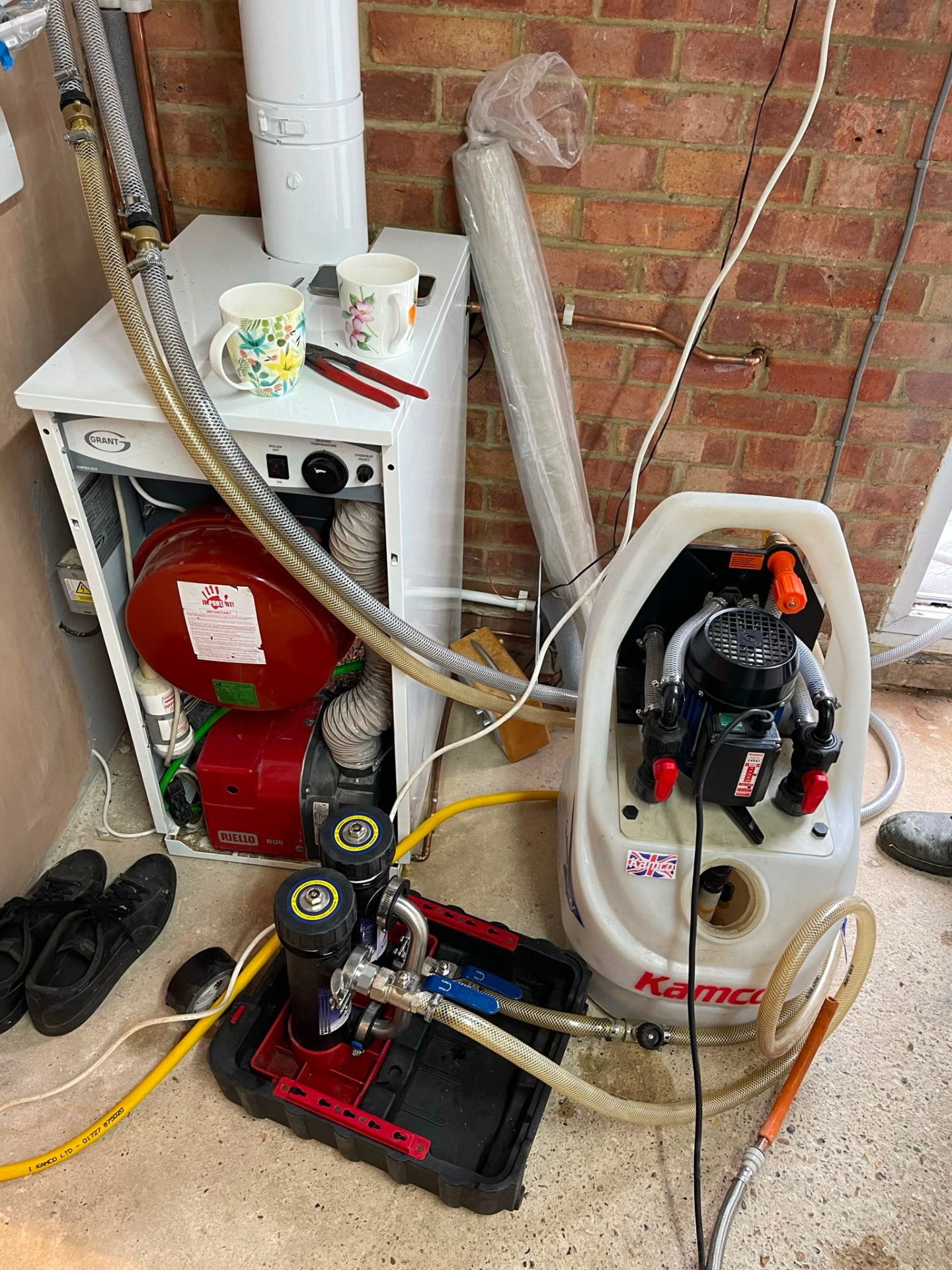
The flushing unit connects to the system and generates high flow at low pressure: high flow is what lifts settled debris, while low pressure avoids stressing older joints. A cleaning chemical is circulated first to break down magnetite and any scale on heat exchange surfaces.
Each radiator is then isolated and flushed individually, with the flow direction reversed to dislodge deposits from the bottom of the panel. Reversal matters: normal circulation flows over the top of settled sludge and leaves it in place, which is why simple drain-and-refill so often changes nothing.
After rinsing to clear water, the system is dosed with a corrosion inhibitor at the correct concentration for its volume. Where relevant we will also discuss scale reduction, since hardness affects heat exchange surfaces as well as sludge.
Older systems need judgement. Where pipework is heavily corroded, aggressive flushing can occasionally reveal pinhole leaks that debris was effectively plugging. We assess the condition first and tell you honestly if that is a risk in your property, rather than discovering it halfway through.
Microbore systems, common in houses built in certain periods, use narrow pipework that blocks far more readily than standard pipe. They benefit substantially from flushing but need careful attention, since a fully blocked microbore leg may need individual clearing.
Results vary with starting condition. A moderately sludged system usually shows a clear improvement in radiator temperature and boiler behaviour the same day. A system where a radiator is completely blocked internally may need that radiator replaced, and we will tell you if that looks likely before starting.
We powerflush systems in Braintree, Colchester, Kelvedon, Tiptree, Feering, Halstead, Sudbury, Sible Hedingham, Coggeshall and the surrounding villages. Much of the housing stock here is old enough that systems have been in service for decades, frequently with no record of ever having been chemically treated.
Powerflushing is often combined with other work: fitting a new boiler, replacing radiators that are beyond recovery, or an annual service where the filter contents made the problem obvious. Combining jobs means one drain-down and one visit instead of two.
Local coverage
Based in Earls Colne, Colchester. See the full service area map or read verified customer reviews.
Recent work
Photographs from real powerflushing jobs completed across Essex and Suffolk. More on the our work page.
Questions
Something not covered here? Call 07984 042373: the 24-hour line is usually answered personally by Matt.
It is quoted as a fixed price based on the number of radiators, the condition of the system and access. The assessment and quote are free, and we will tell you if a cheaper chemical clean would achieve the same result.
Most domestic powerflushes are a full day's work, depending on radiator count and how contaminated the system is. Larger or heavily sludged systems can take longer, and we will say so before starting rather than mid-job.
The strongest signs are radiators cold at the bottom, some rooms never heating properly, black water when bleeding, boiler kettling or banging, and a pump that is noisy or has already been replaced. We confirm it by checking radiator temperature patterns and the water and filter condition.
In most cases yes, because cold-at-the-bottom radiators are caused by settled sludge. Where a radiator is completely blocked or internally corroded beyond recovery, replacement is the answer, and we will identify that at assessment.
Not always, but the system must be clean. Where contamination is mild, a chemical clean, inhibitor and a magnetic filter is enough. Where it is heavy, a powerflush protects both the new appliance and its manufacturer warranty.
That depends almost entirely on what happens afterwards. With a full inhibitor dose, a magnetic filter fitted and emptied at each annual service, a flushed system stays clean for years. With no inhibitor, corrosion restarts as soon as the system is refilled.
Powerflush units run high flow at low pressure specifically to avoid stressing joints. On very old, corroded pipework there is a possibility of exposing pinhole leaks that debris was masking. We assess the system's condition first and discuss that risk with you openly.
A clean system circulates freely, reaches temperature faster and lets a condensing boiler return water cool enough to condense. That is a genuine efficiency gain compared with a system fighting restricted flow.
Yes, all our workmanship carries a 6-month guarantee, and we hold £2,000,000 public liability insurance.
Yes, along with Kelvedon, Tiptree, Feering, Halstead, Sudbury, Sible Hedingham, Coggeshall and the surrounding Essex and Suffolk villages.
Next step
Free assessment, an honest answer on whether you need a full powerflush or just a chemical clean, and a fixed price before any work starts.
Call 07984 042373